
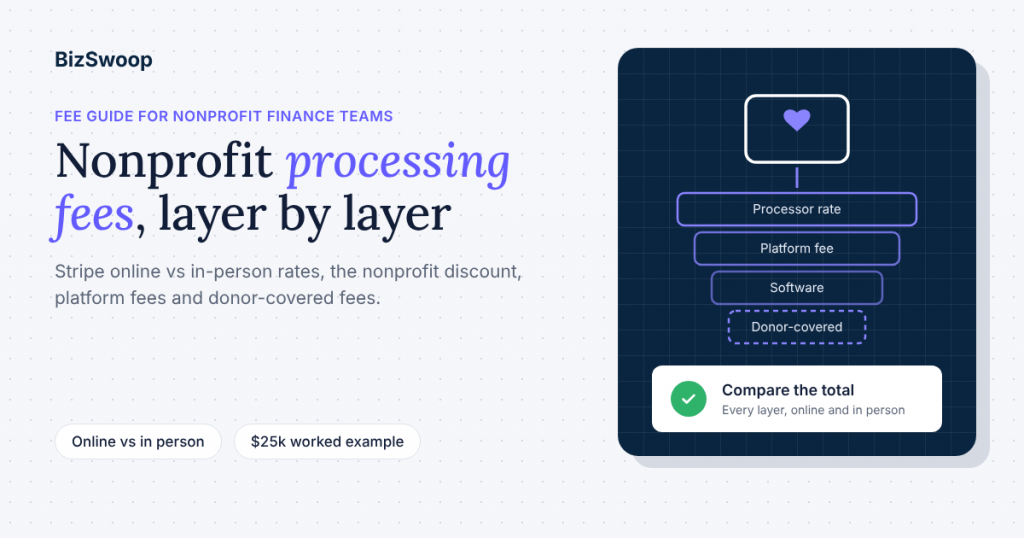
A U.S. nonprofit typically pays about 3% to 5% of each card donation in fees, split across layers. Nonprofit payment processing fees are a processor rate (Stripe’s standard U.S. rate is 2.9% + 30¢ online and 2.7% + 5¢ in person), any platform fee your giving software adds, the software subscription itself, and optional donor-covered fees or tips that shift part of the cost to the donor.
Fees look small on a single gift and large on an annual budget. This guide is for executive directors, finance leads and development directors who want to know what card donations actually cost, where the money goes, and which levers move the number. It separates online from in-person rates (most fee articles don’t), explains what Stripe’s nonprofit discount does and doesn’t say, takes “zero-fee” platforms at face value, covers donor-covered fees in Give (formerly GiveWP), and works through a $25,000 GivingTuesday with real arithmetic. GivingTuesday is Tuesday, December 1, 2026, so this is the right month to decide.
BizSwoop has been in business since 2016 and a Stripe Partner since 2020. We make Tap To Donate for Give by Jovvie, an in-person payments add-on for Give, so we say where our fee sits and where another model costs less.
Key Takeaways
- Fees come in layers. Processor rate, platform fee, software subscription and optional donor-covered fees or tips; compare the total, not one line.
- In-person gifts cost less to process than online gifts. Stripe’s U.S. card-present rate is 2.7% + 5¢ against 2.9% + 30¢ online, and the fixed fee is what hurts small gifts.
- Stripe’s nonprofit discount publishes no rate. Eligibility requires at least 80% of your Stripe volume to come from tax-deductible donations, and you apply through Stripe support.
- “Zero-fee” platforms move the cost to donors. Tip-funded models ask donors for an optional contribution to the platform on top of the gift.
- Donor-covered fees can offset most processing costs. Give’s Fee Recovery add-on (Pro and Elite plans) lets donors choose to cover fees on your forms, including in-person gifts taken with Jovvie.
- The cheapest rate isn’t always the cheapest choice. A second platform with its own donor list costs staff time in reconciliation and follow-up that rarely shows up on the fee line.
How much does it cost a nonprofit to process card donations?
A U.S. nonprofit on Stripe’s standard pricing pays 2.9% + 30¢ per successful online card donation and 2.7% + 5¢ per in-person card donation, before any platform or software fees (Stripe pricing). Add a platform fee and the all-in cost typically lands between about 3% and 5% of the gift.
What that looks like per gift, using Stripe’s standard U.S. rates for domestic cards:
| Gift | Online (2.9% + 30¢) | In person, card reader (2.7% + 5¢) | In person, Tap to Pay (adds $0.10) |
|---|---|---|---|
| $10 | $0.59 (5.9%) | $0.32 (3.2%) | $0.42 (4.2%) |
| $25 | $1.03 (4.1%) | $0.73 (2.9%) | $0.83 (3.3%) |
| $50 | $1.75 (3.5%) | $1.40 (2.8%) | $1.50 (3.0%) |
| $100 | $3.20 (3.2%) | $2.75 (2.75%) | $2.85 (2.85%) |
| $250 | $7.55 (3.0%) | $6.80 (2.7%) | $6.90 (2.8%) |
These figures are the processor layer only. International cards add 1.5% and currency conversion adds 1% under Stripe’s pricing, and a dispute carries a $15 fee. ACH Direct Debit is far cheaper at 0.8% capped at $5, which is why it’s worth offering for large or recurring gifts where your platform supports it.
What are the layers in nonprofit payment processing fees?
Nonprofit payment processing fees have four layers: the processor, the platform, the software plan and, optionally, the donor. Each one is set by a different party, and only the first is unavoidable.
| Layer | Who sets it | Typical form | Example |
|---|---|---|---|
| 1. Processor (card networks and acquirer) | Stripe, PayPal, Square or a merchant bank | Percentage + fixed fee per transaction | Stripe U.S.: 2.9% + 30¢ online; 2.7% + 5¢ in person |
| 2. Platform fee | Your giving software or add-on | Percentage per transaction, sometimes only on some gift types | Jovvie: 0.5%–2% on in-person donations only, by volume |
| 3. Software plan | Your donation platform or CMS add-ons | Annual or monthly subscription | Give itself is free; Give Pro ($399/year) or Elite ($599/year) only if you want add-ons such as Fee Recovery or Recurring Donations |
| 4. Donor-covered fees or tips | You (fee coverage) or the platform (tips) | Optional amount the donor adds at checkout | Give Fee Recovery; tip-funded “zero-fee” platforms |
Interchange, the share that goes to the card-issuing bank, sits inside layer 1. On flat-rate processors such as Stripe you don’t see it separately; on interchange-plus pricing from a merchant bank, you do. For most small and mid-sized nonprofits, flat-rate pricing is simpler to budget and reconcile.
Here’s where Jovvie sits, in the official wording from the WordPress.org listing: free plugin, free Jovvie account, no monthly fees or contracts. Platform fee: a small percentage on in-person donations only, 0.5% to 2% depending on your donation volume, in addition to Stripe’s processing rate. The fee applies only to donations taken through the Jovvie gateway; online Give donations are unaffected.
How do online and in-person donation processing fees differ?
In-person donations cost less to process because the card is physically present, which lowers fraud risk; Stripe’s U.S. card-present rate is 2.7% + 5¢, compared with 2.9% + 30¢ for online cards. The fixed fee drives most of the gap.
On a $100 gift the difference is 45¢. On a $10 gift it’s 27¢, almost half the online fee. Event giving, church offerings and GivingTuesday pop-ups produce exactly those small gifts, which is why taking them as card-present payments matters.
Two practical notes:
- QR codes and NFC stickers are online payments. When a donor scans a code and completes a web form on their own phone, the gift is card-not-present and priced at the online rate, even though the donor is standing in front of you.
- Tap to Pay adds a per-authorization fee. Stripe charges $0.10 per Tap to Pay authorization on top of the card-present rate. It’s still cheaper than the online fixed fee, and it removes the need to buy a reader.
Most fee comparisons quote a single “nonprofit rate” and stop there. If you take a meaningful share of gifts in person, model the two channels separately.
Does Stripe offer a nonprofit discount, and who qualifies?
Yes, Stripe offers discounted processing fees to eligible nonprofits, but its support article doesn’t publish the discounted rate (Stripe: fee discount for nonprofit organizations). Figures you’ll see elsewhere, such as 2.2% + 30¢, come from third parties; confirm your rate with Stripe after approval.
According to Stripe, to qualify your organization must:
- Be a registered nonprofit with valid tax documentation of that status.
- Operate in an eligible country. Stripe lists the United States, Canada, Australia, New Zealand and 20 European countries.
- Take at least 80% of its Stripe payment volume as tax-deductible donations. Membership fees, tuition, ticket sales, registration fees and auction payments don’t count toward the 80%.
You apply by contacting Stripe support from the account you want discounted, with your account ID, a donation-volume confirmation and tax-exempt documentation such as an IRS determination letter.
Two things finance leads should know before counting on it:
- The 80% test is per Stripe account. If the same account sells gala tickets, auction items or gift-shop merchandise, those sales count against you. Some organizations keep a separate Stripe account for non-donation revenue.
- The article doesn’t mention Terminal or in-person payments. Ask Stripe support directly whether your discount applies to card-present transactions before you budget for it.
See Stripe for nonprofits for Stripe’s broader nonprofit offering.
Modeling fees before GivingTuesday? A Jovvie advisor can walk your finance team through processor rates, the Jovvie platform fee on in-person gifts, and how online and in-person donations reconcile in Give and Stripe, before December 1.
Are “zero-fee” donation platforms really free?
“Zero-fee” platforms are free to the nonprofit, not free to the donor. Tip-funded platforms such as Zeffy cover their costs, including card processing, with optional contributions donors add at checkout; Zeffy says it “relies entirely on optional contributions from donors” and that donors can and often do skip them (Zeffy: how is Zeffy free?).
That model has real advantages, and some honest trade-offs:
- Best for: small organizations with no website or donor database, or with no budget for fees at all. For them, a tip-funded platform is often the right answer.
- Cost to donors: the contribution prompt asks the donor for more money at the moment of giving. Some donors pay it without noticing; some find it confusing; some pay less to your cause to compensate.
- Deductibility: a tip paid to a for-profit platform is generally not a charitable contribution to your organization, so it shouldn’t appear on your receipt as part of the gift.
- Data and workflow: gifts and donor records live in the platform’s system. If you also run online giving in Give or a CRM, you’ll be reconciling two donor lists.
The fee you don’t pay still has a cost: the donor pays it, or your staff pays it in time spent merging records.
Should nonprofits ask donors to cover processing fees?
Usually, yes: offering donors the option to cover fees is common, transparent and, for many organizations, recovers a large share of processing costs. Make it optional and pre-explained, not a surprise.
- Make it a choice. A checkbox such as “Add $1.75 to cover processing fees” with a one-line reason works better than a default that donors have to notice and remove.
- Show the dollar amount, not a percentage.
- Receipt the full amount. When a donor voluntarily covers fees on a gift paid to your organization, the total they pay you is generally treated as part of their contribution. Confirm the treatment with your tax advisor.
- Track coverage rates by form and channel, so you know what share of fees you actually recover.
How do donor-covered fees work in Give?
Give’s Fee Recovery add-on, included in the Pro and Elite plans, adds an option on your donation forms for donors to cover processing fees (Give plans on Liquid Web). Set the fee it adds to reflect your processor’s actual rate, so donors cover what you really pay.
Fee Recovery works with Jovvie’s in-person gateway, so donors can cover the fees at an event or on Sunday too. It can be switched on or off per payment gateway (Fee Recovery changelog), which matters for mixed online and in-person giving:
- Online forms: set the fee to Stripe’s online rate for your country.
- In-person gifts through Jovvie: set the fee to the in-person rate (Stripe’s card-present rate plus Jovvie’s platform fee) and run one test gift in Jovvie’s Test Mode before the event, so staff know what donors will see.
What would a $25,000 GivingTuesday actually cost in fees?
On these assumptions, a $25,000 GivingTuesday with 30% of dollars given in person costs about $815 to $928 in processing and platform fees, or 3.3% to 3.7% of the total. Here’s the arithmetic, using Stripe’s standard U.S. rates for domestic cards and no nonprofit discount.
Assumptions:
- Online: $17,500 from 175 gifts (average $100) on Give with Stripe.
- In person: $7,500 from 150 gifts (average $50) through Jovvie; half on card readers, half on Tap to Pay.
- No donor-covered fees, no international cards, and Give plan costs excluded (you pay them anyway for online giving).
| Line | Calculation | Fee |
|---|---|---|
| Online processing | 2.9% × $17,500 + 175 × $0.30 | $560.00 |
| In-person processing | 2.7% × $7,500 + 150 × $0.05 | $210.00 |
| Tap to Pay authorizations | 75 × $0.10 | $7.50 |
| Jovvie platform fee (in person only) | 0.5%–2% × $7,500 | $37.50–$150.00 |
| Total | $815.00–$927.50 | |
| Share of $25,000 | 3.3%–3.7% |
What the numbers say:
- The online channel is most of the cost. $560 of the total comes from online gifts, and the 30¢ fixed fee alone is $52.50 of that.
- In person, all-in, costs 3.4% to 4.9%. That’s $255 to $367.50 on $7,500, depending on where your volume puts the Jovvie fee.
- The QR-code alternative isn’t automatically cheaper. If the same 150 donors scanned a code and gave online instead, processing would be $262.50 (3.5%). That’s about the same as Jovvie at the low end of its range and about $105 less at the top end. The difference is what you get for it: a tap takes seconds, and many donors at a busy table won’t stop to fill in a web form on their phone.
- Donor-covered fees change the picture most. If even half of online donors covered fees, you’d recover roughly $280 of the $560 online cost.
Treat this as a model, not a quote. Plug in your own average gift, channel split and rates.
Which payment processor is best for nonprofits?
The best processor for a nonprofit is the one your donation platform supports well, with transparent flat-rate pricing and a nonprofit discount you qualify for. For WordPress organizations on Give, that’s usually Stripe, because Give’s online forms and Jovvie’s in-person payments settle to the same Stripe account.
How the three common models compare for an organization weighing in-person giving:
| Stripe + WordPress (Give + Jovvie) | Bundled giving platform | Tip-funded “zero-fee” platform | |
|---|---|---|---|
| Online card processing | Stripe’s rate (nonprofit discount if eligible) | Platform’s rate | Covered by donor tips |
| In-person processing | Stripe card-present rate + Jovvie 0.5%–2% (in person only) | Platform’s in-person rate | Covered by donor tips |
| Subscription | None for Jovvie: it works on the free Give plugin (a paid Give plan only for add-ons like Fee Recovery) | Often a monthly plan for extra features | None |
| Donor data | One database in Give, online and in person | In the platform | In the platform |
| Better fit when | You already fundraise on a WordPress site with Give | You want everything in one hosted system | You have no website, no budget for fees, or no donor database |
Our nonprofit in-person payments strategy guide covers the decision in more depth, and a full comparison of in-person donation tools is coming next in this series.
How should finance teams budget and reconcile donation fees?
Budget fees as a percentage of gross by channel, and reconcile against net payouts. Stripe deposits gifts net of its fees, so your bank deposit won’t match the gross total in Give.
- Budget by channel. Use around 3.5% for online and 3% to 5% for in person, then refine with your own data after one campaign.
- Book gross revenue and fees separately. Record donations at the gross amount in your books and processing fees as an expense, rather than booking net deposits as revenue.
- Match by payout. Each Stripe payout bundles many gifts; reconcile the payout report against Give’s donation report for the same dates.
- Watch refunds and disputes. Refunds for in-person donations through Jovvie are issued from the Stripe dashboard, not from inside Give, so keep a short log of who issued them and why.
- Review the platform-fee tier after your busiest season, since Jovvie’s in-person fee depends on donation volume.
A detailed walkthrough of reconciling in-person and online donations across Give and Stripe payouts is planned for this series.
Frequently asked questions
What is a normal payment processing fee for a nonprofit?
On Stripe’s standard U.S. pricing, 2.9% + 30¢ per online card donation and 2.7% + 5¢ per in-person card donation. With platform fees, most nonprofits’ all-in cost is roughly 3% to 5% of each card gift.
Do processing fees count as charitable donations?
When a donor voluntarily adds an amount to cover processing fees on a gift paid to your organization, the total is generally treated as part of their contribution. A tip paid to a for-profit platform generally isn’t a contribution to your charity. Confirm with your tax advisor.
Does Stripe give nonprofits a discount?
Yes, for eligible registered nonprofits where at least 80% of Stripe payment volume is tax-deductible donations. Stripe doesn’t publish the discounted rate; apply through Stripe support and confirm the rate, and whether it covers in-person payments, after approval.
Is the Stripe nonprofit rate 2.2% + 30¢?
That figure is widely quoted by third parties, but Stripe’s support article on the nonprofit discount doesn’t state a rate. Budget on the standard rate until Stripe confirms yours.
Are zero-fee donation platforms really free?
They’re free to the nonprofit. Tip-funded platforms cover their costs with optional contributions that donors add at checkout, so the cost shifts to donors who choose to pay it.
What does Jovvie charge for in-person donations?
The plugin and Jovvie account are free, with no monthly fees or contracts. A platform fee of 0.5% to 2% applies to in-person donations only, depending on donation volume, in addition to Stripe’s processing rate. Online Give donations aren’t affected.
What is the 5% rule for nonprofits?
The “5% rule” usually refers to the requirement that U.S. private foundations distribute about 5% of their net investment assets each year for charitable purposes. It isn’t a rule about processing fees, though some organizations use 5% as an informal ceiling for total payment costs.
Should we accept ACH or bank payments for large gifts?
Yes, if your platform supports it. Stripe’s ACH Direct Debit is 0.8% capped at $5, so a $5,000 gift costs $5 by ACH instead of about $145 by card.
Talk to a Jovvie advisor about your donation fees
Fees are worth managing, but they’re rarely the biggest cost in a nonprofit’s giving stack; a second donor database is. If your organization already raises money online with Give, Jovvie adds in-person giving with no monthly fee and a clearly stated platform fee on in-person gifts only, so every donation lands in one database and one Stripe account. A Jovvie advisor can model your channel mix and walk your finance team through payouts and reconciliation before GivingTuesday on December 1.
Sources and primary documentation: Tap To Donate for Give by Jovvie on WordPress.org, Jovvie for Give, How Tap to Donate Technology Works and What It Costs (Liquid Web), Stripe pricing, Stripe: fee discount for nonprofit organizations, Stripe for nonprofits, Give plans (Liquid Web), Give Fee Recovery changelog, Zeffy: how is Zeffy free?.
