
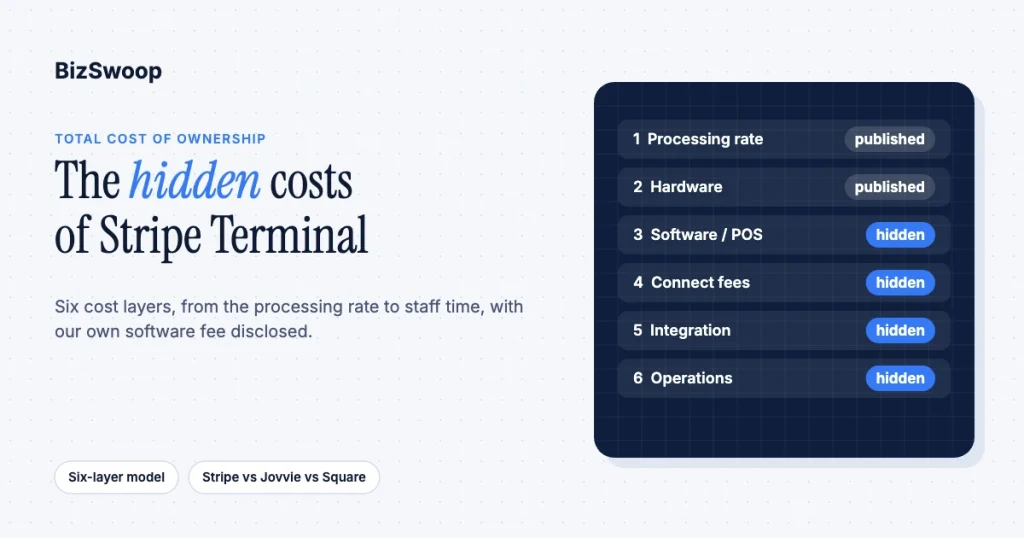
The real cost of Stripe Terminal is six layers, not the 2.7% + 5¢ in-person rate everyone quotes. They are: (1) the processing rate and its add-ons, (2) one-time hardware, (3) the POS or software layer, (4) Connect application-fee economics that decide who pays Stripe’s fees, (5) one-time integration or build cost, and (6) ongoing operational cost like reconciliation and staff time. Stripe’s published fees cover the first two layers accurately. Most “Stripe Terminal fees explained” posts stop there, which is why businesses that budget from them get surprised by the software, integration, and operations lines. This piece models all six so you can see the number that shows up on your P&L.
We build and operate Stripe Connect platforms: BizSwoop runs its own Connect platform at payments.bizswoop.app, and Jovvie has shipped in-person payments for WordPress and WooCommerce merchants since 2016, so these are layers we price into real deployments. We also do something “how to pay $0 in fees” posts won’t: we put Jovvie’s own published fees inside the model, because a total-cost breakdown that hides the author’s line item isn’t one. Every Stripe figure cites Stripe’s primary pricing pages and was re-checked in November 2026. For the per-transaction detail, see the Stripe Terminal fee structure guide; for devices, hardware costs explained.
Key Takeaways
- Stripe’s published fees are only two of six layers. The rate and hardware are on Stripe’s pages; software, Connect economics, integration, and operations are not.
- The rate has add-ons. On top of 2.7% + 5¢, Stripe charges +1.5% for international cards, +10¢ per Tap to Pay authorization, and $15 for each dispute received.
- Hardware is the layer people over-weight. A $299 S700 amortized over three years costs under $10 a month.
- Software is never free. It is paid through a subscription, a per-transaction platform fee, a higher processing rate, or your own engineering time; Jovvie, for example, charges a monthly plan plus a 0.5–2.5% platform fee.
- Connect charge types decide who pays Stripe. With destination charges, Stripe’s fee comes out of the platform’s balance, so the application fee has to cover it.
- Operations compound. Five hours a week of manual reconciliation at $40 an hour is about $870 a month that never appears on a pricing page.
What are the real costs of Stripe Terminal?
The real cost of Stripe Terminal is the sum of six layers: Stripe’s 2.7% + 5¢ card-present rate and its add-ons, hardware, the software or POS layer, Connect application-fee economics, integration or build cost, and operational overhead. A small merchant’s true cost is dominated by the rate and software; a platform or ERP build is dominated by integration and Connect economics.
Here is the whole model in one table before we walk each layer.
| Layer | Cost | Who pays | Notes |
|---|---|---|---|
| 1. Processing rate | 2.7% + 5¢ per in-person charge | Merchant (or per Connect setup) | Add-ons: +1.5% international, +10¢ Tap to Pay, $15 per dispute |
| 2. Hardware (one-time) | $59 (M2) to $329 (T600); S700/S710 $299 | Merchant | Multi-year life; cellular data $10/reader/month if used |
| 3. Software / POS layer | $0 (raw API) to a subscription, a platform fee, or both | Merchant | The line most fee posts omit |
| 4. Connect application fees | Set by the platform (application_fee_amount) | Merchant, platform, or split, by charge type | Destination charges debit Stripe’s fee from the platform |
| 5. Integration / build (one-time) | $0 (plugin) to tens of thousands (custom or ERP) | Merchant or platform | Capital cost, amortized over the deployment |
| 6. Operational (ongoing) | Staff time, reconciliation, support | Merchant | Real but rarely budgeted |
The rest of this guide takes each layer in order and ends with a total-cost comparison: Stripe Terminal alone, Stripe Terminal with Jovvie, and Square.
What does Layer 1, the processing rate, really include?
The base cost is Stripe’s card-present rate of 2.7% + 5¢ per successful in-person transaction in the US, with add-ons for international cards, Tap to Pay, optional encryption, disputes, and faster payouts.
Stripe’s in-person rate is documented on its Terminal pricing and explained in its credit card terminal rates guide. It is lower than the 2.9% + 30¢ online rate, and the distinction matters: some fee posts quote the online number for in-person sales. The add-ons that stack:
- International cards: +1.5% when the card was issued outside your country, plus a currency-conversion fee if the charge converts currencies.
- Tap to Pay: +10¢ per authorization when you take the payment on an iPhone or Android phone instead of a reader.
- Point-to-point encryption: +5¢ per authorization if you opt into P2PE, which some industries require.
- Disputes: $15 for each dispute received, plus a $15 fee if you counter it (refunded only if you win), per Stripe’s pricing page.
- Instant Payouts, if used: 1.5% of the payout, with a 50¢ minimum, for moving funds faster than the free standard schedule.
For a merchant doing $50,000 a month in card-present sales at a $25 average ticket (2,000 transactions), Layer 1 alone is $50,000 × 2.7% + 2,000 × 5¢ = $1,350 + $100 = $1,450 a month, before any add-ons. That is where most fee posts stop.
What does Layer 2, hardware, cost?
Hardware is a one-time cost of $59 to $329 per reader in the US, and it is the layer businesses over-worry about because it is the most visible; amortized over a reader’s multi-year life, it is small next to the rate.
| Reader | US price | Connectivity | Typical use |
|---|---|---|---|
| Tap to Pay on iPhone/Android | $0 hardware (+10¢ per authorization) | Phone’s internet | Mobile, field, line-busting |
| Stripe Reader M2 | $59 | Bluetooth to a phone or tablet | Cheap handheld paired to a tablet |
| BBPOS WisePOS E | $249 | Wi-Fi | Countertop without a custom app |
| Stripe Reader S700 | $299 | Wi-Fi, Ethernet with hub | Smart countertop or handheld reader |
| Stripe Reader S710 | $299 (+$10/month cellular) | Cellular and Wi-Fi | Off-site or no-Wi-Fi locations |
| Stripe Reader T600 | $329 (+$39 optional Reader Hub) | Wi-Fi, Ethernet with hub | Fixed counter, 8-inch customer display |
Prices are from Stripe’s Terminal devices page, checked November 2026; the BBPOS WisePad 3 is not sold in the US. A $299 S700 amortized over three years is about $8 a month, against $1,450 a month in processing for the example merchant. That is why “how much does a Stripe reader cost” is the wrong question to anchor a budget on.
What does Layer 3, the software layer, cost?
The software that turns a Stripe reader into a working checkout costs a subscription, a per-transaction platform fee, a higher processing rate, or engineering time, and it is often the second-biggest line.
A Stripe Terminal reader authorizes cards; it does not know your prices, inventory, tax, or receipts. Something has to supply that, and each option has a different cost shape:
- Raw Stripe Terminal API: no software fee, high build cost. You build the POS yourself and pay for it in Layer 5 (build) and Layer 6 (maintenance).
- A subscription POS. Many POS platforms charge a monthly fee per location; some, like Square’s Free plan, charge no software fee and earn through the processing rate instead.
- A subscription plus a platform fee. This is where we disclose our own line item. Jovvie’s published pricing is $29 a month (Basic) or $49 a month (Pro), plus a platform fee of 0.5% to 2.5% on credit card transactions, on top of Stripe’s processing rate; the Jovvie Pay tier is $0 a month plus a 1% platform fee. For the example $50,000-a-month merchant on Pro, that is $49 plus $250 to $1,250 a month in platform fees. We put that number in the model on purpose: a “hidden costs” article that hid the author’s own fee would be exactly what this piece exists to correct.
The honest takeaway: “free” software is paid for somewhere, through the rate, a platform fee, or your own engineers. There is no free layer, only different places the cost lands, so compare them against your volume and ticket mix.
How do Layer 4 Connect fees change who pays?
For platforms, marketplaces, and ISVs reselling Terminal, the application fee and the charge type decide who bears Stripe’s processing fee, and getting it wrong inverts your margin.
Under Stripe Connect, your platform sets an application_fee_amount (your cut) on each Terminal PaymentIntent, as described in Stripe’s Connect pricing and Use Terminal with Connect. The critical variable is the charge type:
- Direct charges: the charge is created on the connected account, which pays Stripe’s processing fee by default, and your application fee is pulled out to your platform.
- Destination charges: the charge is created on your platform account and funds are transferred to the connected account. Stripe’s destination charges documentation says your platform’s balance is debited for Stripe fees, refunds, and chargebacks, so your application fee has to cover Stripe’s fee before it becomes margin.
The trap is concrete: price a 1.5% application fee as margin on destination charges, while your platform also pays Stripe’s 2.7% + 5¢, and you lose money on every transaction. The two fees must be modeled together. For a single-merchant deployment with no Connect, Layer 4 is $0, which is worth saying so small merchants don’t over-model it.
Running WooCommerce and want in-person sales without a custom build? Jovvie adds a Stripe Terminal POS to your store, with our fees published up front.
What does Layer 5, integration, cost?
Integration is a one-time capital cost from $0 for an off-the-shelf plugin to tens of thousands of dollars for a custom or ERP build, and for anyone connecting Terminal to an existing system it is often the largest single number in the model.
The tiers below are typical planning ranges from our own project scoping, not published prices; get quotes for your stack.
| Integration path | One-time cost | When it fits |
|---|---|---|
| Off-the-shelf plugin (e.g. Jovvie on WooCommerce) | About $0 build | Existing WooCommerce store, standard retail or POS needs |
| Pre-built connector (mid-market SaaS or ERP) | About $5,000–$15,000 | A supported connector exists but needs configuration and mapping |
| Custom build or ERP integration (NetSuite, SAP, bespoke) | $50,000 or more | Multi-entity accounting, custom reconciliation, no off-the-shelf path |
Amortized, a $50,000 build over three years is about $1,390 a month; a plugin path is close to $0. That one decision often swings total cost of ownership more than the processing rate does, which is why build versus buy is the highest-leverage question to answer before touching hardware.
What does Layer 6, operations, cost?
The last layer never appears on a pricing page: the ongoing human cost of running in-person payments, including reconciliation, refunds, dispute handling, staff training, and support.
It shows up as bookkeeping time matching Terminal payouts to orders (smaller when the POS and accounting share one system), staff time on refunds and disputes, training new counter staff, and the support burden of a DIY build when a reader misbehaves. A raw-API build has the lowest software fee (Layer 3) but the highest operational and maintenance cost (Layer 6); a managed POS or plugin costs more in Layer 3 and less in Layer 6. The cost doesn’t disappear, it moves.
To put a number on it: if reconciliation and payment support take five hours a week of a manager’s time at a loaded $40 an hour, that is about $870 a month, more than the hardware and, for many merchants, comparable to the software layer. When payouts reconcile automatically against orders because the POS and the ledger share one system, that number shrinks; when someone matches a payout report to a spreadsheet every morning, it grows. Spending on Layer 3 and Layer 5 buys down Layer 6, and Layer 6 compounds with volume and headcount.
How does Stripe Terminal alone compare with Stripe + Jovvie and Square?
Here is the same merchant modeled across every layer: $50,000 a month in card-present volume, 2,000 transactions at a $25 average ticket, an existing WooCommerce store, one location, and no Connect.
| Cost layer | Stripe Terminal alone (raw API) | Stripe Terminal + Jovvie Pro | Square (Free plan) |
|---|---|---|---|
| Processing rate | 2.7% + 5¢, about $1,450/mo | 2.7% + 5¢, about $1,450/mo | 2.6% + 15¢, about $1,600/mo |
| Hardware (amortized) | About $8/mo (S700, $299) | About $8/mo (S700, $299) | About $8/mo (Square Terminal, $299) |
| Software / POS layer | $0 fee, high build | $49/mo + 0.5–2.5% platform fee ($250–$1,250/mo) | $0 on the Free plan |
| Connect application fees | $0 (single merchant) | $0 (single merchant) | N/A |
| Integration / build (amortized) | High (custom build) | About $0 (plugin) | About $0 |
| Operational | Highest (you maintain it) | Low (managed plugin) | Low (managed app) |
| Best for | Teams with engineering to spare | WooCommerce merchants who want one catalog online and in person | Merchants happy to run Square’s own POS and catalog |
Square figures are from Square’s fees page and Square Terminal page; Stripe’s from Stripe pricing and Stripe Terminal, all checked November 2026. The honest reading: at this ticket size, Stripe’s rate is about $150 a month cheaper than Square’s Free-plan rate. Raw Stripe Terminal is cheapest on paper and most expensive in engineering and operations. Jovvie’s platform fee is a real per-transaction cost, so it makes sense when the plugin replaces a custom build and cuts operational time, not as a way to lower your rate. Square is the simplest all-in-one if you are comfortable running its own POS and catalog. If you are comparing Stripe POS options, put each one’s software fee and integration cost in this table, not just the rate.
Frequently asked questions
Does Stripe Terminal have monthly fees?
Stripe charges no monthly account fee for Terminal on standard pricing; you pay 2.7% + 5¢ per US in-person transaction and a one-time hardware cost, plus $10 per reader per month only if you use cellular data. Monthly costs usually enter through the software layer, such as a POS subscription or platform fee.
How much does a Stripe Terminal reader cost?
In the US, Stripe readers cost $59 for the Stripe Reader M2, $249 for the BBPOS WisePOS E, $299 for the S700 or cellular S710, and $329 for the T600. Tap to Pay on iPhone or Android needs no hardware but adds 10¢ per authorization. Hardware is a one-time cost.
What is the Stripe Terminal transaction fee?
The US in-person Stripe Terminal fee is 2.7% + 5¢ per successful transaction, lower than Stripe’s 2.9% + 30¢ online rate. International cards add 1.5%, Tap to Pay adds 10¢ per authorization, and optional P2PE adds 5¢ per authorization.
Does Stripe charge a fee for disputes or chargebacks?
Yes. Stripe charges $15 for each dispute received on Terminal transactions, and another $15 if you counter the dispute, which is refunded only if you win, per Stripe’s pricing page. Low-ticket, high-volume merchants should budget an expected dispute rate rather than assuming zero.
Are there hidden fees with Stripe Terminal?
Stripe’s own fees are published, but the hidden costs are the layers its pricing page doesn’t cover: the software or POS layer (a subscription, a platform fee such as Jovvie’s 0.5–2.5%, or engineering time), Connect application-fee economics for platforms, one-time integration cost, and ongoing operational cost. Modeling only Stripe’s rate under-counts the true total cost of ownership.
Want an honest total-cost model for your deployment?
If you are budgeting Stripe Terminal for a real business, especially a platform, an ERP-connected operation, or a multi-location merchant, the number that matters is the six-layer total, not the headline rate. Talk to a Jovvie advisor and we will model your volume, integration path, and Connect structure with every layer, including ours, on the table.
Sources: Stripe Terminal pricing · Stripe pricing · Stripe Terminal devices · Stripe Connect pricing · Destination charges · Use Terminal with Connect · Jovvie pricing · Square fees
