
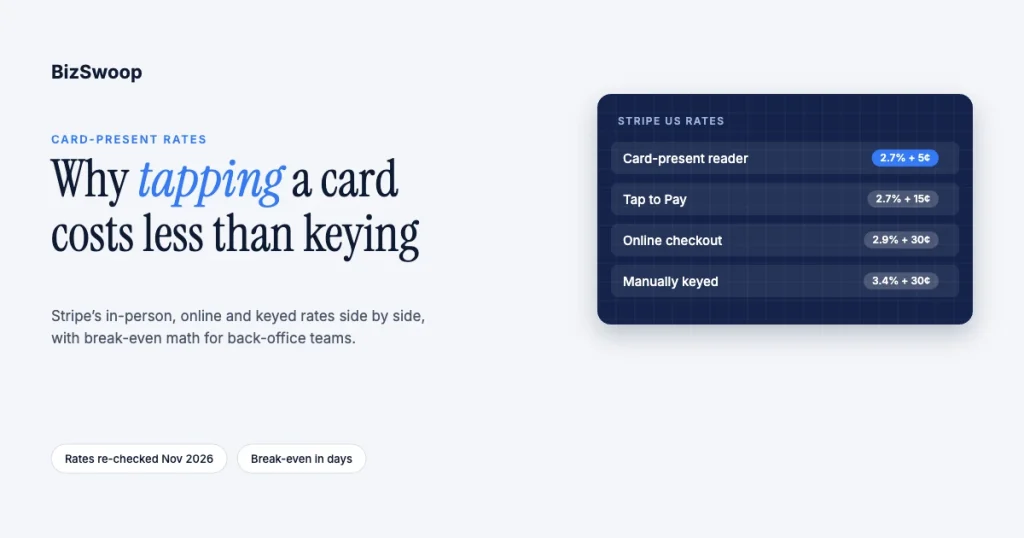
Card-present rates on Stripe are lower because an in-person card is far less risky. A physically tapped or dipped card is much less likely to be fraudulent than a keyed or online one, so the card networks charge less to process it and Stripe passes that through: 2.7% + 5¢ for a US in-person Terminal charge versus 2.9% + 30¢ online, and 0.5% more again when a card is typed in by hand. For any business that still keys phone, invoice, or back-office orders while the customer is standing there, moving that revenue to a tap captures the discount on every transaction and often pays back a reader in days. This guide explains why the discount exists, gives the current numbers from Stripe’s pricing page, and turns them into a back-office cost-reduction plan with break-even math.
We build and operate Stripe Connect platforms: BizSwoop runs its own payment service at payments.bizswoop.app, and Jovvie has shipped card-present flows for WooCommerce merchants since 2016. This piece belongs with our guide to Stripe Terminal for back-office payments, and every Stripe rate below was re-checked against stripe.com/pricing in November 2026.
Key Takeaways
- In person is cheaper on both parts of the fee. Stripe charges 2.7% + 5¢ for a US card-present transaction versus 2.9% + 30¢ online, so the flat fee drops by 25¢ on every sale.
- Keying a card costs the most. A card typed into the Dashboard is priced as an online payment plus 0.5% for manual entry, about 3.4% + 30¢.
- The discount is risk pricing. Chip and contactless cards authenticate themselves, shift counterfeit-fraud liability away from the merchant, and are harder to dispute.
- Small tickets save the most. A $12 sale costs about 65¢ online but about 37¢ tapped, a 43% cut in the fee.
- A reader pays for itself fast. Moving $30,000 a month of keyed volume to a $59 M2 saves at least about $2,520 a year, a payback of roughly nine days.
- Only convert cards that are physically present. Real phone orders, e-commerce and card-on-file renewals stay card-not-present.
Why are card-present rates lower than card-not-present rates?
Card-present rates are lower because the fraud risk is lower, and payment pricing is risk pricing. When a customer taps or inserts a chip card, the chip authenticates the card cryptographically and the card is demonstrably present; when a number is typed into a website or read over the phone, none of that verification happens and the merchant carries more fraud and dispute risk, which the networks price into higher interchange.
- Fraud is far lower in person. Federal Reserve payments-fraud research (Federal Reserve Payments Study) has consistently found card-not-present fraud to be much more common than card-present fraud.
- Chip verification and the liability shift. When an EMV chip card is read by a chip-capable reader, liability for counterfeit-card fraud moves away from the merchant, a real reduction in risk exposure.
- Lower dispute exposure. Card-not-present transactions are a leading source of chargebacks, while a chip- or PIN-verified in-person sale is harder to dispute successfully.
Stripe’s own resource pages explain the split and the pricing logic: Card-present vs. card-not-present transactions, Credit card terminal rates, and, for the mechanism underneath, Interchange fees 101.
What are Stripe’s card-present and card-not-present rates?
Stripe’s US card-present rate is 2.7% + 5¢ per successful in-person charge, versus 2.9% + 30¢ for a standard online charge, and a manually entered card adds 0.5% on top of the online rate. The flat fee matters most: 5¢ versus 30¢ is a 25¢ difference on every transaction.
| Card-present (Terminal reader) | Tap to Pay on a phone | Card-not-present (online) | Manually keyed | |
|---|---|---|---|---|
| Stripe US rate | 2.7% + 5¢ | 2.7% + 15¢ (5¢ + 10¢ per authorization) | 2.9% + 30¢ | 3.4% + 30¢ (online rate + 0.5%) |
| How the card is captured | Tapped, dipped or swiped at a reader | Tapped on a phone | Entered in a checkout form | Typed into the Dashboard or a virtual terminal |
| Counterfeit-fraud liability on chip | Shifts away from merchant | Contactless, card authenticated | Merchant | Merchant |
| Chargeback exposure | Low | Low | Higher | Higher |
International cards add 1.5% in person and online, online currency conversion adds 1%, and optional P2PE on Terminal adds 5¢ per authorization. These are Stripe’s standard published US rates; large merchants can ask Stripe about custom volume pricing, so treat the published figures as a ceiling.
Two practical notes. First, because of the flat fee, the card-present discount is proportionally largest on small tickets: a $12 sale costs about 65¢ online and about 37¢ tapped at a reader, a 43% cut. Second, the 0.5% manual-entry fee is the quietest line in most back offices: every phone order or invoice someone types into the Stripe Dashboard pays the online flat fee and the manual-entry fee, relative to what the same card would cost tapped.
How does converting keyed orders to card-present taps cut costs?
If you take orders by phone, by invoice, or at a back-office desk and key the card while the customer is physically there, you are paying about 3.4% + 30¢ on revenue that could be charged at 2.7% + 5¢. The real question behind “why are card-present rates lower” is operational: where in my business am I keying cards I could be tapping?
- “Phone orders” that are really in person. Many are customers at a counter or picking up while staff key the card into the Dashboard out of habit. If the card is present, tap it. For genuinely remote phone orders, keying is the right call.
- Invoice settlement at pickup or delivery. B2B and trade businesses that email invoices and then key the card when the customer pays at collection leave the discount on the table. A counter reader or Tap to Pay in the field captures it.
- Deposits and balances collected on site. Deposits, balances, and account top-ups taken while the customer is on-site should be tapped, not keyed.
The hardware is trivial: Tap to Pay on iPhone or Android needs no reader, and a Stripe Reader M2 is $59, which is why the break-even below is so favorable.
Taking in-person payments in a WooCommerce store? Jovvie turns Stripe Terminal into a full POS for your store, with our fees published up front.
When do card-present savings cover the cost of a reader?
The break-even is usually days, not months, because the hardware is cheap and the saving applies to every converted transaction. Moving a keyed charge (3.4% + 30¢) to a reader (2.7% + 5¢) saves 0.7% of the amount plus 25¢; moving it to Tap to Pay (2.7% + 15¢) saves 0.7% plus 15¢.
Worked example for a business that keys $30,000 a month ($360,000 a year) and moves it to card-present:
| Scenario | Rate before | Rate after | Annual saving | Hardware | Payback |
|---|---|---|---|---|---|
| Reader, percentage saving only | 3.4% + 30¢ | 2.7% + 5¢ | ~$2,520 plus 25¢ per transaction | $59 (M2) | ~9 days |
| Tap to Pay, percentage saving only | 3.4% + 30¢ | 2.7% + 15¢ | ~$2,520 plus 15¢ per transaction | $0 | Immediate |
| Small-ticket heavy | 3.4% + 30¢ | 2.7% + 5¢ | Grows with transaction count | $0–$59 | Days |
Even at a tenth of that volume, $3,000 a month of keyed orders, the ~$252 a year percentage saving covers a $59 M2 in under three months. The math only fails when your convertible keyed volume is tiny; then the honest answer is that it isn’t worth changing anything.
To run your own number: annual saving ≈ (monthly convertible keyed volume × 12 × 0.007) + (annual converted transactions × $0.25 for a reader, or $0.15 for Tap to Pay). If that beats the one-time hardware cost, the move pays for itself in the first year, usually in the first weeks.
Why do most Stripe fee guides get the card-present number wrong?
Most fee guides blur the card-present rate by leading with 2.9% + 30¢, the online rate, and mentioning in-person pricing as a footnote, so a business planning in-person or hybrid sales anchors on the wrong number. The clean version is all you need to plan:
- In person at a reader: 2.7% + 5¢.
- In person with Tap to Pay: 2.7% + 5¢ plus 10¢ per authorization.
- Online checkout: 2.9% + 30¢.
- Manually keyed in the Dashboard or a virtual terminal: 2.9% + 30¢ plus 0.5%.
International cards add 1.5% in any channel, so an in-person charge on a foreign card is not simply 2.7% + 5¢; our Stripe Terminal fee structure guide covers every add-on. A rate is only trustworthy if you can see when it was checked and against which source.
Can you get the card-present rate without the card present?
No. Stripe prices each transaction by how the card was actually captured, so the saving only comes from reading the card in person with a reader or Tap to Pay. The discount is a risk transfer: take away the chip authentication by keying the number, and you lose both the rate and the liability protection, which is why keyed transactions cost more and leave you more exposed to chargebacks.
- Don’t try to “fake” card-present. Keying a card never earns the card-present rate.
- The liability shift is a second, uncounted benefit. Moving keyed volume to chip or tap also lowers chargeback exposure on that volume, a cost most break-even analyses ignore. Stripe’s Terminal documentation covers the in-person flow.
When is keeping card-not-present the right call?
Card-not-present is correct whenever the card genuinely isn’t physically there, and forcing a reader into those flows adds friction and hardware for no rate benefit.
- The customer is truly remote, as with real phone orders, e-commerce, or remote invoicing.
- The charge is a card-on-file renewal. Subscription renewals are card-not-present by nature.
- The workflow change costs more than the saving, which, per the math above, is rare but real at very low keyed volume.
The rule of thumb: convert every transaction where the card is already physically present but currently keyed, and leave genuinely remote payments where they are. If you are choosing software for the in-person side, a POS for Stripe should make tapping the default, not keying.
Frequently asked questions
Why are card-present rates lower than card-not-present rates?
Because a physically tapped or dipped card is much less likely to be fraudulent, and when a chip card is read by a chip reader, counterfeit-fraud liability moves away from the merchant. The card networks charge less for that lower risk, and Stripe passes the difference through as a lower in-person rate.
What is Stripe’s card-present rate?
Stripe’s standard US card-present rate is 2.7% + 5¢ per successful in-person transaction at a Terminal reader, versus 2.9% + 30¢ for a standard online charge. Tap to Pay adds 10¢ per authorization and international cards add 1.5%.
What is the difference between card-present and card-not-present fees?
The percentage is slightly lower in person (2.7% versus 2.9%) and the flat fee is much lower (5¢ versus 30¢). A manually keyed card costs a further 0.5%, about 3.4% + 30¢ in total. On small tickets the flat-fee gap is usually the bigger saving.
How can I lower my credit card processing fees?
The lever most businesses miss is tapping cards that are physically present instead of keying them, which moves those payments from about 3.4% + 30¢ to 2.7% + 5¢. Beyond that, ask Stripe about custom pricing at high volume, reduce chargebacks, and avoid manual entry wherever possible.
Is it cheaper to swipe or key in a card?
Reading a physically present card at a reader is cheaper than keying it. On Stripe, a keyed card is priced as an online payment plus 0.5% for manual entry, and it carries more chargeback risk because there is no chip authentication.
Does a Stripe reader qualify all my transactions for the card-present rate?
No. Only transactions actually captured at the reader or with Tap to Pay get the in-person rate. Stripe prices each charge by how the card was captured, so a reader does nothing for genuinely remote card-not-present payments.
Reviewing your effective rate?
If you are not sure how much of your volume is keyed while the card is actually present, talk to a Jovvie advisor. We will map your card-present and card-not-present split, size the convertible volume, and give you the break-even on moving it to Stripe Terminal, and if the numbers say leave it alone, we will tell you.
Sources: Stripe pricing · Stripe Terminal pricing · Card-present vs. card-not-present transactions · Credit card terminal rates · Interchange fees 101 · Federal Reserve Payments Study · Stripe Terminal docs
