
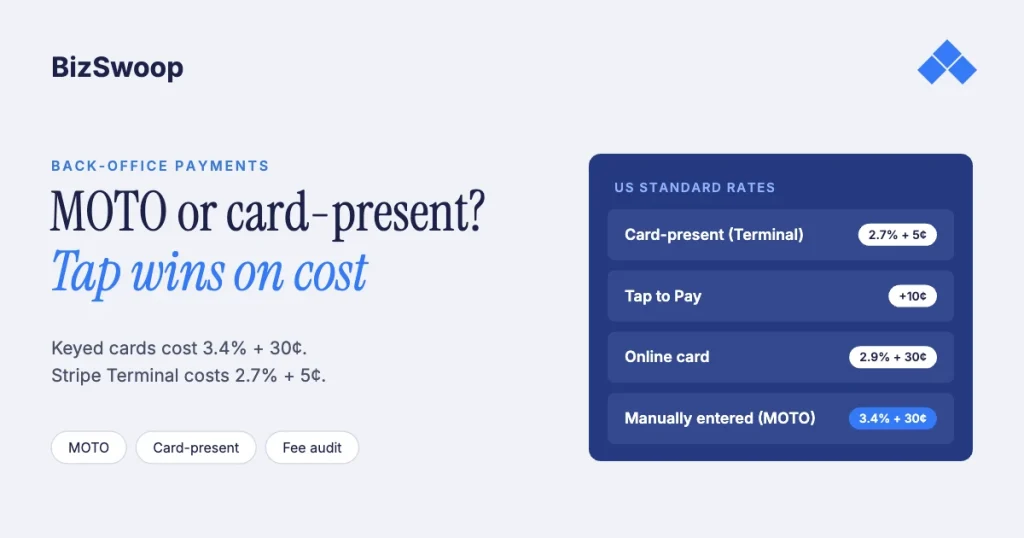
Stripe Terminal is cheaper than MOTO for any payment you could take card-present. Stripe’s standard US in-person rate is 2.7% + 5¢ per transaction. A card typed in by staff (a mail order or telephone order, or MOTO, payment) is priced as a manually entered online card: 2.9% + 30¢ plus 0.5%, or 3.4% + 30¢. That’s a gap of 0.7 percentage points plus 25¢ on every transaction. This guide runs the numbers at $10,000, $100,000 and $1,000,000 a month, and shows how to tell which MOTO payments are unavoidable and which are habit.
Jovvie, an official Stripe Partner, has built in-person Stripe Terminal payments for WooCommerce merchants since 2016. Rates below were re-checked on Stripe’s pricing page in November 2026. This guide sits in the back-office pillar, Stripe Terminal for back-office payments; read that first if you’re still deciding whether you need a POS at all.
Key Takeaways
- Card-present costs less. US in-person cards are 2.7% + 5¢; manually entered cards are 3.4% + 30¢, so each keyed payment costs 0.7% + 25¢ more.
- The savings scale with volume. At a $250 average ticket, moving $100,000 a month from MOTO to card-present saves about $800 a month, or $9,600 a year.
- Stripe prices MOTO higher because of fraud. Stripe says manually entered payments cost more because of the higher fraud rates of collecting card details by phone or other unencrypted sources.
- MOTO gets no card-present protections. Stripe’s docs say MOTO payments are card-not-present, so card-present pricing and liability shifts don’t apply.
- Much MOTO volume is habit. A customer who orders by phone and then picks up in person can tap at pickup instead of having the card keyed in.
- The switch is cheap. Tap to Pay needs no hardware (+10¢ per authorization); a Stripe Reader M2 is $59.
Is Stripe Terminal cheaper than MOTO?
Yes. Stripe Terminal’s US card-present rate is 2.7% + 5¢, against 3.4% + 30¢ for a manually entered card, so Terminal is cheaper at every ticket size and the dollar gap grows with the ticket.
| Payment method | US standard rate | On a $200 charge | On a $1,000 charge |
|---|---|---|---|
| Manually entered card (MOTO in the Dashboard or on a Terminal reader) | 3.4% + 30¢ | $7.10 | $34.30 |
| Stripe Terminal, card-present (tap, chip, swipe) | 2.7% + 5¢ | $5.45 | $27.05 |
| Online card (checkout or API) | 2.9% + 30¢ | $6.10 | $29.30 |
| Savings, MOTO → Terminal | 0.7% + 25¢ | $1.65 (23%) | $7.25 (21%) |
Tap to Pay adds 10¢ per authorization, so a $200 Tap to Pay payment costs $5.55, still $1.55 less than keying it in. International cards add 1.5% to both card-present and online rates. Stripe’s support article on manually entered card payments says the higher fee reflects “increased fraud rates” when card details are collected by phone or other unencrypted sources.
What are MOTO payments, and why do they cost more?
MOTO stands for mail order/telephone order: a payment where the customer gives card details by phone or mail and staff type them into the Stripe Dashboard or a reader instead of reading the physical card. It’s a card-not-present transaction.
The premium exists because a keyed payment carries none of the signals a physical card read does. A chip or contactless read authenticates the card itself. A staff member typing a number from a phone call has no chip data and no proof the cardholder is present. Stripe’s MOTO documentation is explicit that MOTO payments are card-not-present and that card-present features such as liability shifts and pricing don’t apply.
It’s the manual entry that triggers the higher rate, not the phone call. A customer who calls to order and then taps a card at pickup makes a card-present payment. That distinction is the basis of the audit below.
How much does MOTO cost at $10K, $100K and $1M a month?
At a $250 average ticket, each payment costs $8.80 keyed in and $6.80 card-present, a $2.00 difference. Here’s what that adds up to.
| Monthly volume | Transactions (at $250) | MOTO fees | Card-present fees | Monthly savings | Annual savings |
|---|---|---|---|---|---|
| $10,000 | 40 | $352 | $272 | $80 | $960 |
| $100,000 | 400 | $3,520 | $2,720 | $800 | $9,600 |
| $1,000,000 | 4,000 | $35,200 | $27,200 | $8,000 | $96,000 |
The savings scale linearly because both rates have the same shape, a percentage plus a flat fee. At $10,000 a month, $960 a year is easy to ignore. At $1,000,000 a month, $96,000 a year is a budget line that justifies changing a workflow.
Two caveats. The table assumes every MOTO dollar can move to card-present, which is never fully true; see the audit next. And ticket size matters: smaller tickets make the 25¢ flat-fee gap a bigger share of each payment, while large B2B tickets make the 0.7% gap dominate. Run your own average ticket before quoting a number.
Taking phone orders that customers collect in a WooCommerce store? Jovvie runs pickup payments on Stripe Terminal readers and Tap to Pay.
Is your business paying the MOTO premium out of habit?
Probably, for part of its volume. Split your MOTO payments into unavoidable and MOTO-by-default before assuming you need new hardware or software.
Unavoidable MOTO is a genuine remote payment where the customer is never present: a mail-order catalog, a call-center sale, or a renewal taken by phone because the customer called in. There’s no card-present alternative, so the higher rate is the cost of that channel.
MOTO-by-default is everything else. Common patterns:
- Phone order, in-person pickup. Staff key the card during the call because they already have the number, though the customer will be at the counter later.
- Field visits. A rep writes down a card number on site and keys it in later, instead of tapping the card on Tap to Pay or a Stripe Reader M2.
- Front-desk requests. A clerk keys a card from a form or email while the payer is in the building and could be handed a reader.
- Busy events. A booth staffer notes a card number to process later instead of taking the tap on the spot.
None of these needs infrastructure beyond a normal Terminal setup: Tap to Pay on phones staff already carry, a Stripe Reader M2 ($59) for staff who move around, or a Stripe Reader S700 or S710 ($299) at a fixed desk. Walk one representative month of MOTO payments and tag each one “customer was physically reachable” or “customer was genuinely remote.” The first group is where the savings table becomes real money.
What fraud and chargeback risk does MOTO carry?
More than card-present, and that risk is part of what the higher rate prices in. A keyed payment has no chip cryptogram and no contactless authentication, so a stolen card number read over the phone processes like a legitimate one. Because MOTO doesn’t get card-present liability shifts, the merchant has less to stand on when a fraud dispute comes in.
That cuts both ways. Moving a MOTO-by-default payment to card-present saves the rate difference and also removes a fraud vector. For volume that has to stay MOTO, keep your fraud checks in place: Stripe’s MOTO flow on a reader prompts for card number, CVC, expiry and postal code, and Stripe reminds you that you’re responsible for verifying the customer’s identity.
What does it take to move back-office payments to card-present?
Mostly a workflow and training change. Most back offices can pilot it within one billing cycle.
- Hardware. If staff phones support Tap to Pay, there’s nothing to buy; card-present pricing applies as soon as the customer taps (plus 10¢ per Tap to Pay authorization). For chip-only cards or a full field day, a Stripe Reader M2 is $59 and pairs over Bluetooth with a phone or tablet.
- Reconciliation. Both payment types are PaymentIntents with the same webhook events. The visible difference is the payment method type (card_present instead of card). If your accounting sync reads Stripe’s data rather than a manual MOTO flag, nothing needs to change.
- Connect platforms. Application fees are set by the platform on each PaymentIntent, whatever the capture method. See the Stripe Connect platform economics guide.
- Training. Teach staff to ask “can this person tap a card right now?” before keying anything. For phone-order pickups, take payment at pickup instead of at order time, which also avoids charging no-shows.
- Pilot. One location, one reader and one trained staff member for a week is enough to check the savings against your real data.
Which Stripe readers support MOTO?
Stripe’s smart readers do. Per Stripe’s MOTO docs, a smart reader such as the S700 or S710 can show a form where staff enter the card number, CVC, expiry and postal code, and you request access from Stripe support before using it. Those payments are still card-not-present and priced as manually entered cards. You can also key cards in the Stripe Dashboard or a custom virtual terminal. Our Stripe Terminal vs Virtual Terminal guide compares the two.
In practice, a back office that handles both uses a card-present device (Tap to Pay, a Stripe Reader M2, or an S700 or S710) for anyone reachable in person, and MOTO entry only for the genuinely remote payments found in the audit.
Frequently asked questions
What is a virtual terminal, and how is it different from MOTO?
A virtual terminal is the tool: a form in the Stripe Dashboard or a custom page where staff key in a card number. MOTO is the transaction category for a card taken by mail or phone and entered that way. Both are card-not-present and priced as manually entered cards.
How do I get MOTO processing with Stripe?
You can key a card into the Stripe Dashboard as a manually entered payment. To take MOTO payments on a Stripe Terminal smart reader, contact Stripe support for access first, as Stripe’s MOTO documentation explains.
Does MOTO increase chargeback or fraud risk?
Yes. Stripe says manually entered payments carry higher fraud rates, which is why they cost more, and MOTO payments don’t get card-present liability shifts.
Does switching to Tap to Pay or a Stripe Reader M2 change refunds?
No. You refund against the original PaymentIntent the same way, whether it was card-present or keyed in.
Is the MOTO rate the same outside the US?
No. Rates vary by country and currency. The 3.4% + 30¢ and 2.7% + 5¢ figures here are Stripe’s US standard pricing; check stripe.com/pricing for your country.
How much can I save by moving MOTO payments to Stripe Terminal?
In the US, 0.7% plus 25¢ per payment moved, or 0.7% plus 15¢ with Tap to Pay. At a $250 average ticket that’s $2.00 per payment, about $800 a month on $100,000 of volume.
Want the numbers for your own MOTO volume?
Send us a month of keyed payments and we’ll split it into unavoidable and MOTO-by-default, and estimate what moving to card-present would save. If those customers pick up in a WooCommerce store, a POS for Stripe like Jovvie takes the payment at the counter.
Sources: Stripe pricing · Stripe Docs: MOTO payments · Stripe Support: manually entered card payments · Stripe: MOTO payments 101 · Tap to Pay
